Essay · March 15, 2026 · Andrew Moore, Co-founder & CEO
Why we’re spending our heartbeats building Daisy
A note from co-founder Andrew Moore on a broken collarbone, a Warren Buffett book, and why the problems worth working on are the ones you have to stand in a milking parlor to understand.
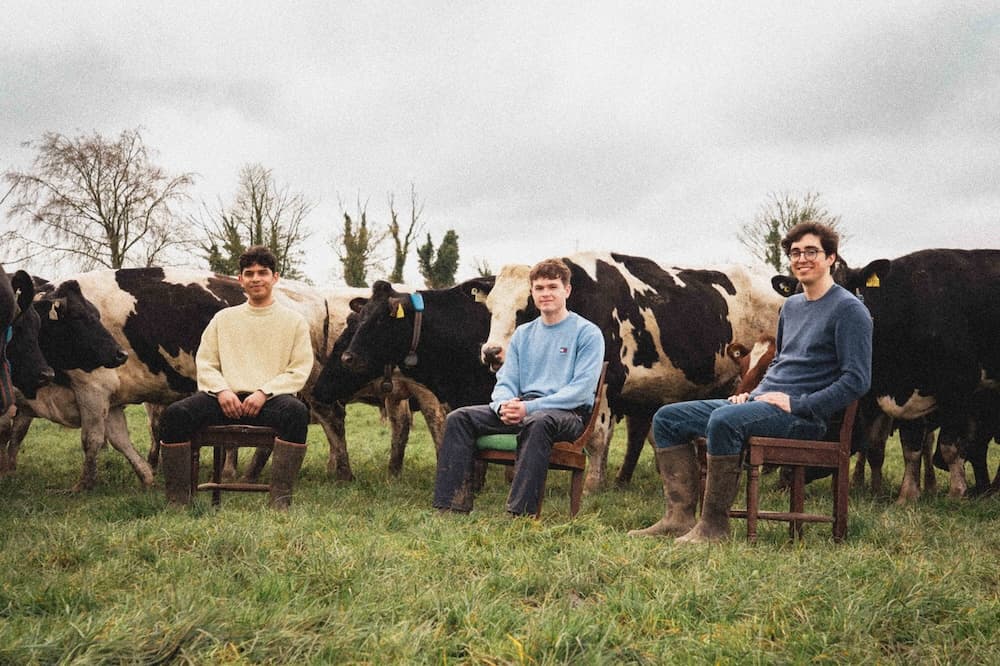
I grew up on a dairy farm in Ireland, and for most of my life I assumed I’d spend the rest of mine on one. The summer I was seventeen I broke my collarbone playing Gaelic football, and for two months I couldn’t do anything useful. I couldn’t play football. I couldn’t work on the farm. School was out. So I started reading.
One of the first books I picked up was about Warren Buffett. What struck me wasn’t any particular idea of his. It was that he seemed to love his job the way most people love a sport, or a person. The adults around me didn’t love their work, they tolerated it. Loving your work seemed to be something most people had quietly given up on.
I thought about this a lot while my collarbone healed. I had been assuming for most of my life that I would take over the farm. That’s what eldest sons on farms do. I liked the farm. But I was starting to suspect that “liked” wasn’t going to be enough. If I was going to spend sixty years on one thing, it needed to be a thing I thought about when no one was paying me to.
The more I talked to people across different industries, the more I realized they were all running into the same problem. Forecasting and production planning. I stumbled into it wondering how it worked in farming.
The part I got interested in was what happens after the milk leaves the farm. I assumed, going in, that somewhere between the cow and the fridge there had to be a hyper-complex algorithm doing all of this. The companies processing billions of liters of milk into thousands of products must, I figured, be running on some quietly impressive piece of software nobody outside the industry had ever heard about. Then I actually went to meet them, and got a shock. The whole thing was running on Excel. Huge operations, with a lot of money at stake, planned in spreadsheets built on very limited data, a handful of variables, and a great deal of human gut intuition. That gap, between what I had assumed to exist and what was actually there, is where I started falling in love with the problem. Especially because these are brutally volatile businesses. A bad season on the other side of the world can move their prices by a third, and none of that volatility shows up in the spreadsheet.
The first time I saw this I assumed I must be missing something. These are real companies with real engineers and real budgets. Someone must have tried to fix it. And someone has — repeatedly, for twenty or thirty years. There’s a long history of dashboards and consulting projects and forecasting tools in this industry, almost none of which stuck. So the question isn’t “why has nobody tried?” It’s “why has nobody succeeded?”
The reason, I think, is that the problem doesn’t look like what it is. From a distance it looks like a spreadsheet problem. You see words like yields, shrink, planning horizons, allocation, and you think that surely someone has built software for this. And they have. It hasn’t stuck, because you cannot solve this problem by being very clever from a desk in San Francisco. You have to actually know the industry, in a way that doesn’t come from reading about it. You have to know what it costs a plant to stop producing butter and start producing cheese, and how long the changeover takes, and who has to be on shift while it’s happening. You have to know why a plant manager will sometimes run the “wrong” product to keep a long customer relationship alive. You have to know what it means when a family has been running the same business for four generations. It’s tempting to treat this kind of knowledge as surface detail — something you pick up on the way. It isn’t surface. It’s structure. Without it you build something that demos well and gets ignored in production, which is, roughly, what has happened every time before now.
The most interesting problems to work on right now are the ones that look boring from the outside and require you to physically be somewhere to understand.
The combination is useful, because it keeps most people away. The problems that are easy to see from a laptop have already been picked over by many excellent people. The problems that require you to stand in a milking parlor at five in the morning have, for fairly obvious reasons, not.
I remember the first time I flew to the US after we had a handful of customers running live. The flight attendant handed me a small packet of butter for my bread and a small pouch of milk for my tea. The butter had one of our customers’ logos on it. The milk had another. I sat there at thirty thousand feet staring at them, more moved than I should have been. Most software you write disappears into a screen. Ours ends up on tray tables, and in fridges, and in babies’ bottles.
Something else happens when you work with customers like this that I didn’t expect. They come to you from a lifetime of doing everything by hand, and once they decide you’re worth their time, they become unreasonably invested in whether you succeed. The feedback is direct. They’ll tell you, on a call, that a number on one of our screens is off by four percent and why. That kind of feedback makes our team work unreasonably hard for them. It’s a loop you don’t really understand until you’re inside one.
If I’m honest with myself about why I care about this problem more than others I could reasonably be working on, the answer comes back to the people. Not “users” in the abstract sense. The specific kind of person I grew up around — my father, my neighbors, the families who’ve been running their businesses for three or four generations. They aren’t easily impressed. But once you have actually helped them, they stay. You can build something durable with customers like that in a way you cannot really build with the users of most consumer apps.
Who you work with ends up shaping who you become more than what you work on does.
One thing I’ve learned, starting this company, is that who you work with ends up shaping who you become more than what you work on does. How honest you are, what you treat as normal, what you are willing to tolerate in yourself. We’re trying to build a team of genuine, intelligent people who actually care about this particular problem. Not the kind of person who will email me because they heard agriculture is “in.” The kind who will read something like this and quietly think that these are problems they want to spend the next several years of their life on, and that these are people they want to spend them with.
If that’s you, andrew@daisy.inc.
— Andrew Moore, Co-founder & CEO